Peter Drucker Management Theory Pdf
- Peter Drucker Management Theory
- Peter Drucker Management Theory Pdf
- Peter Drucker Management Theory Pdf Template
- Peter Drucker Management Theory Pdf Example
- Peter Drucker Management Theory Pdf Free
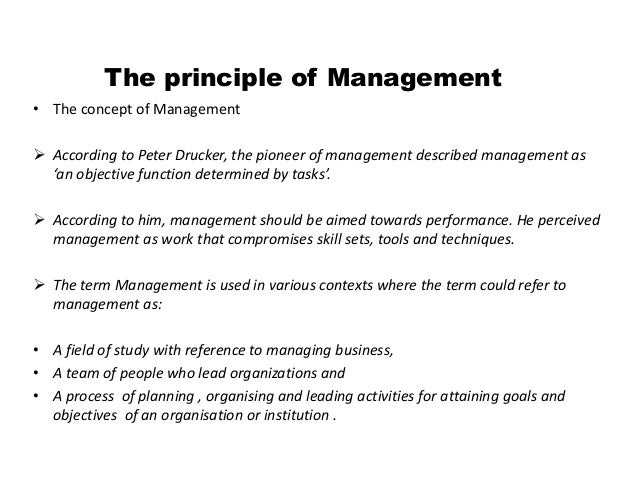
Peter F Drucker Management Rev Ed. Drucker’s view of managers as humans who relate to other individuals was the most profound. However, Drucker also applied the analytical tools of evolution and pragmatism with power. 2.1 Humans and relations. Drucker saw management as a human activity, which dealt with each worker and manager as a unique individual (Drucker, 1979). Would you like to get the full Thesis from Shodh ganga along with citation details? ADVERTISEMENTS: Some of the major contributions of Peter Drucker are as follows: 1. Nature of Management 2. Management Functions 3. Organisation Structure 4. Management by Objectives 6. Usb endoscope camera software download. Organizational Changes. Among the contemporary management thinkers, Peter Drucker outshines all. He has varied experience and background which include psychology, sociology, law, and journalism.
The father of modern corporate management Peter Drucker is often considered to be the world’s most influential corporate guru. His ideas and thoughts revolutionized corporate management in the later half of the 20th century.
Drucker questioned why in both the classical and human relations schools of management, effectiveness was automatically considered to be a natural and expected outcome. According to him effectiveness was more important than efficiency and was the foundation of every organization.
©[Andrey Burmakin]/Adobe Stock Tekken 5 for android free download.
He thereby developed Management by Objectives (MBO) through his 1954 book ‘The Practice of Management’. MBO deals with a certain type of interaction, specific to a manager and his employee. MBO is based on the thinking that various hierarchies within companies need to be integrated. There was a need for commitment, responsibility and maturity. There was a need for a common challenge. Here MBO becomes a process by which the objectives of an organization are agreed to and decided between the management and the employees, this way the employees understand what is expected of them and help set their own individual goals. Therefore they attain both their personal goals and the organization’s targets.
Every level of management in the organization participates in the strategic planning process and creation of performance systems. The managers of the firm are expected to participate in the strategic planning process to ensure the effectiveness in the implementing of the plan. The managers are expected to apply a range of performance systems, designed to help in the effective functioning of the organization.
An MBO system calls for each level of managers to identify their goals for ever area they are responsible for. These goals are shared then with their individual units. Shared targets guide individuals in fulfilling their role. The role of the management now is to monitor and evaluate performance. The focus is on future rather than on past. They check progress frequently and over a set period of time. There is external and internal control in this system with routine assessments. An evaluation is done to understand as to which extent the goals have been met.
An important aspect of the MBO approach is this agreement between employees and managers regarding performance which is open to evaluation. The principle is that when employees are involved with the goal setting and choosing the course of action to be followed by them, they are more likely to fulfill their responsibilities. There is a link between organizational goals and performance targets of the employees.
In MBO goals are expected to be SMART, i.e.
Peter Drucker Management Theory
- Specific
- Measurable
- Achievable
- Realistic, and
- Time bound.
Peter Drucker Management Theory Pdf
Advantages of MBO:
- Objectives are discussed before being agreed upon
- There is participation in setting of goals, deciding the action course and in making decisions
- There is increased motivation and job satisfaction
- Relationships between the managers and those under them improve
- There is better communication within the organisation and increased coordination
- Managers can ensure that objectives of the subordinates are linked to the organization’s objectives
- Objectives can be set at all levels and in various departments
- Objectives can be set individually for each department especially in promotion, marketing, and financial planning
- MBO can be applied in any organisation
- Traits of MBO can be found in industries like the electronic media where performance objectives are carefully established and monitored, particularly in the areas of promotion, marketing, and financial planning
- In an MBO system, employees are more self-directed than boss-directed
Peter Drucker Management Theory Pdf Template
Peter Drucker Management Theory Pdf Example
Disadvantages of MBO:
Peter Drucker Management Theory Pdf Free
- It has to be systematically done
- There is more importance given to the setting of the goals than on the actual outcome or course of action
- It may lead to polarization of efforts, whereby, people or departments are not motivated to look beyond their own targets and help others
- It does not take into consideration, the environment I which the goals are set, like available resources, stake holders, etc
- To avoid potential problems SMART and SMARTER objectives need to be agreed upon
- There is no stimulation of innovation
- Managers start believing in the concept of an “ideal employee” and evaluate their subordinates based on what they expect they should be
- Targets can be misreported and objective setting may become counter –productive to the organization
- Quality of goals set may be poorer or too unrealistic
- It is time-consuming to implement and difficult to maintain
- Setting production targets may encourage resources to meet those targets through whatever means necessary, which usually results in poor quality
- It is not easy to identify all the objectives